



Spain is calling—and it’s serving up far more than paella. Across the country, trade fairs are buzzing with new energy, international brands, and bold design. In fact, Spain has become one of Europe’s most dynamic destinations for business events, drawing exhibitors and attendees from every corner of the world.
While the global exhibiting industry is still evolving post-pandemic, Spain’s transformation is well underway. And it’s not just anecdotal. The numbers tell the same story.
A recent Kongres Magazine article offered key insights about the European exhibition industry. Citing data from UFI, the Global Association of the Exhibition Industry, the piece revealed that by 2023, the exhibiting industry had fully recovered from pre-pandemic levels. However, Spain was among the countries leading the charge, as its exhibition revenues soared 120% compared to the 2019 baseline. To put that into perspective, revenues in Germany, a European exhibiting stronghold, only reached 82% of 2019 figures.
For exhibitors ready to take advantage of this growth, success still requires preparation. So here’s the least you should know before stepping onto the show floor in Spain, from market trends and venues to etiquette and budget considerations.
Economic Impacts
In general, if you are exhibiting in Spain, you can expect:
- Expected Modernization: With rising design and experiential expectations, booths and show producers need to deliver high-quality visuals, service, and hybrid tools (even if physical presence is still dominant).
- Human Resources Matter: Staffing is a known challenge in Spain. If you plan to bring a team or hire local help, you could face significant costs, availability issues, or diminished quality.
- Return on Investment Looks Favorable: Because of faster growth and return to pre-COVID norms, exhibiting could yield good exposure and ROI if done well.
- Government and Industry Support Likely: Given that Spain has already shown public and industry backing for trade fairs (even during difficult periods), regulatory or subsidy support may be more favorable than in some other markets.
Exhibition Venues in Spain
Where might you be exhibiting in Spain? Here are the top venues:
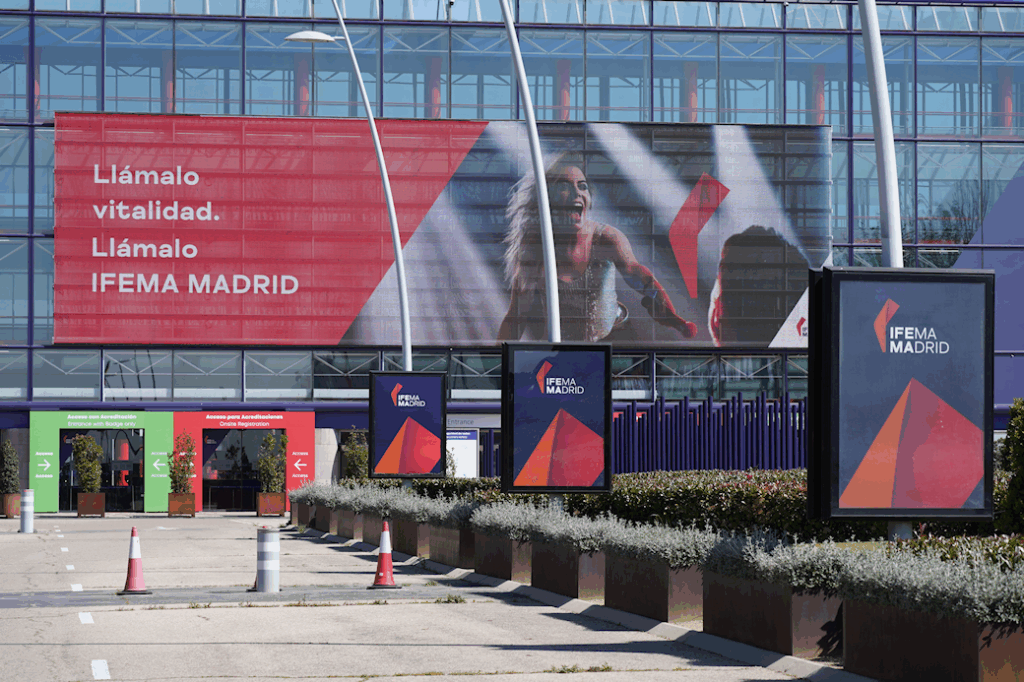
Madrid: IFEMA Madrid hosts trade fairs, congresses, conventions, and other events. With 12 pavilions, two auditoriums, 85 halls, and two catwalks, it offers 2 million square meters of space and is home to more than 500 annual events.
Barcelona: Fira Barcelona is one of the most significant trade fair organizations in Europe. It’s known for the volume and quality of its events, the high standard of its venues, and its organizational expertise. It leads the Spanish trade fair market, especially in industrial and professional fairs, and its reputation is closely tied to the brand of Barcelona, one of Europe’s most vibrant cities, with over a century of trade fair tradition.
Barcelona International Convention Center (CCIB) is part of Fira Barcelona and comprises two buildings: the Convention Centre and the Auditorium CCIB Forum, connected by an underground walkway. With a total surface area of 100,000 m2 and a capacity for up to 15,000 attendees, it is the centerpiece of one of the city’s newest high-tech and business districts, hosting conventions, congresses, fairs, and shows.
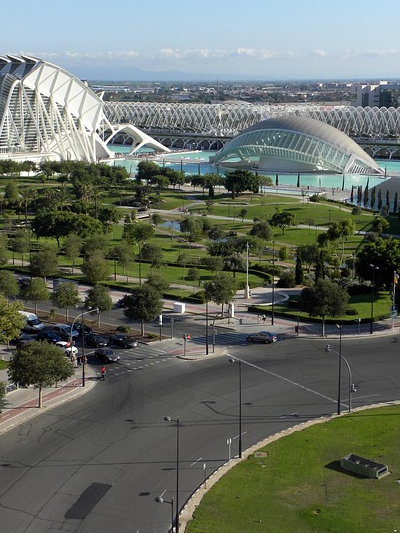
Valencia beautifully blends cutting-edge modern architecture with the captivating allure of old-world charm.
Valencia: Feria Valencia hosts national and international events in a one-of-a-kind Mediterranean setting. Established in 1917, Feria Valencia is the oldest of the venues noted here, and with more than 230,000 square meters of exhibition space, it offers the largest exhibition area in Spain and ranks among the top 10 largest venues worldwide. It offers facilities for exhibitions, conventions, congresses, seminars, meetings, concerts, and various other events with a capacity of up to 20,000 people.
Bibao: The Bilbao Exhibition Centre covers an area of 251,055 square meters and offers six exhibiting pavilions, a shopping mall, and a hotel. In addition to the exhibition halls, the complex has a VIP hall, a conference center, 600 square meters of dedicated office space, and a large atrium. It also has an underground car park with capacity for 4,000 vehicles.
Seville and Málaga: FIBES / Palacio de Ferias Conference and Exhibition Centre of Seville, usually referred to as FIBES or Fibes, offers two buildings, FIBES I and FIBES II, which are connected by a footbridge. In the 1980s, FIBES (an acronym that stands for Feria Iberoamericana de Sevilla, Spanish for Ibero-American Exhibition of Seville) promoted a permanent venue for their activities, and in 1989, FIBES moved to the building purposely designed by Álvaro Navarro Jiménez. In September 2012, the center was expanded with FIBES II, a building designed by Guillermo Vázquez Consuegra that includes a 3,550-seat auditorium.
Business Travel in Spain
Thanks to its modern infrastructure, efficient transport, and excellent hospitality, business travel in Spain is generally easy and enjoyable. But here are some insights to further smooth the travel process.
Getting There
Main Gateways:
- Madrid–Barajas Adolfo Suárez (MAD) — Spain’s largest hub, close to IFEMA
- Barcelona–El Prat (BCN) — Ideal for Fira Barcelona events
- Málaga (AGP) and Valencia (VLC) — Offers access to southern and eastern regions
Connections: Spain is part of the Schengen Area, so flights from other EU countries don’t require passport control.
Accommodation and Business Districts
Book early for major events like MWC Barcelona, FITUR, or Alimentaria, as hotel prices spike.
- Madrid: Business travelers often stay near IFEMA, Paseo de la Castellana, or the Salamanca District.
- Barcelona: Preferred areas include Plaça d’Espanya/ Fira Barcelona, Eixample, or Diagonal Avenue.
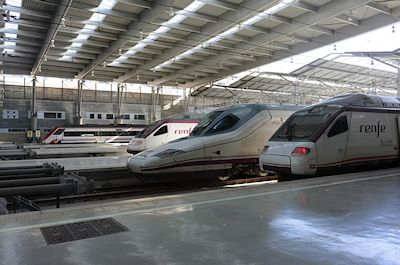
Spain rail system features mid-distance high speed trains
Transportation
- Metro and commuter trains are reliable, safe, and have English-friendly signage. Please keep an eye on your personal belongings and stay vigilant.
- Taxis and rideshares (e.g., Bolt, FreeNow) are widely available in major cities. Uber is offered in select areas.
- High-speed rail (AVE) connects Madrid–Barcelona in ~2.5 hours, and links to Seville, Valencia, and Málaga.
- Car rentals are available at airports, but parking in city centers is limited.
Business Etiquette and Culture
Greetings: Handshakes are standard. In long-term partnerships, two-cheek kisses (left to right) are common among acquaintances.
Language: Spanish is the norm, but English is widely spoken in business settings, especially in Madrid/Barcelona.
Punctuality: Formal meetings are timely and punctual. If the meeting is delayed, expect to be contacted in advance. Casual or social meetings may begin later than scheduled.
Siestas: Although the idea of the Spanish siesta is well-known, the practice has been adapted to modern urban life. Midday closings are common for restaurants and independent retail, and this is often considered family time. The tradition remains a significant part of Spanish culture, often associated with the country’s later mealtimes, mid-day heat, and work-life balance.
Dress Code: Dress is business formal in Madrid and business smart in Barcelona, where industries tend to be slightly more creative.
Dining: Business lunches are popular, often starting around 2 p.m. and lasting one to two hours.
Holidays: When exhibiting in Spain—as in many countries—national holidays are observed, generally by not working.
- New Year’s Day — January 1
- Epiphany (Three Kings’ Day) January 6
- Maundy Thursday (date varies)
- Good Friday — (date varies)
- Easter Monday — (observed in some regions)
- Labor Day — May 1
- Assumption of Mary — August 15
- National Day of Spain (Día de la Hispanidad) — October 12
- All Saints’ Day — November 1
- Constitution Day — December 6
- Immaculate Conception — December 8
- Christmas Day — December 25
In addition to national holidays, each of Spain’s autonomous communities (such as Catalonia, Andalusia, and Galicia) has its own special holidays. For example:
- National Day of Catalonia – September 11
- St. George’s Day – April 23 in Catalonia
- Galicia Day – July 25 in Galicia
- Canary Islands Day, Balearic Islands Day, etc., also exist for specific regions.
- Office Holidays
Money and Costs
- Currency: Euro (€)
- Payment: Credit cards are accepted almost everywhere.
- VAT (IVA): Standard rate 21% (reclaimable for non-EU businesses on some expenses).
Connectivity and SIM Cards
- Prepaid SIMs (e.g., (Movistar, Orange, Vodafone) are available at airports.
- eSIM options are available via Airalo or Holafly.
- Wi-Fi is reliable in hotels, cafés, and exhibition centers.
Entry and Visas
- EU/EEA citizens: No visa required.
- S., U.K., Canada, Australia: Visa-free for stays under 90 days in any 180-day period (Schengen).
- Other countries: Check via Spain’s Ministry of Foreign Affairs.
- Business visitors can attend meetings, trade shows, or short-term training without a work visa for up to 90 days.
Shipping and Customs
- If shipping from outside the EU, use a freight forwarder familiar with trade shows (e.g., DHL Trade Fairs, DVS, DB Schenker, etc.).
- Spain is in the EU, so shipments from EU exhibitors won’t need to clear customs.
- Non-EU exhibitors need an ATA Carnet or temporary import papers for goods.
On-Site Logistics
- Arrange electrical power, internet, and furniture through the show portal. Basic lighting is usually included with shell schemes, but premium lighting and special AV elements will cost more.
- Schedule installation/dismantling times in advance (I&D usually occurs 1–2 days before/after the event).
- Local translators and exhibiting partners can be helpful in navigating logistics.
- Building in enough time for working with organizers is important. The reaction/response time can be extremely slow. Long-term planning ensures answers are received in a timely manner.
Exhibiting Budget Considerations
Space Rental + Custom Stand: You can select “space only” (just the footprint) vs. a turnkey shell scheme. Custom builds allow for special graphics, premium materials, second levels, unique floorplans, etc. The per-square-meter rates vary. (See below.)
Shell / Modular Stand Package: Includes basic walls, floor covering, lighting, standard furnishings, etc. You’ll pay more if you select premium materials, fancy graphics, etc.
Electricity / Power / Lighting Minimum: Depending on power requirements, basic lighting is usually included with shell schemes, but premium lighting, special AV will cost more.
Furniture / AV / Graphics / Branding: Factor in the costs of tables/chairs, screens, signage, print graphics. If you bring your own, transport and set up costs.
Insurance / Liability: Insurance and liability coverage are required by most venues.
Booth Services: Consider cleaning fees, waste removal, security, Wi-Fi, etc. Usually, there are some minimum requirements.
Logistics and Shipping / Customs: If materials are coming from abroad, exhibitors will typically pay for freight, customs/temporary import procedures, and local transport.
Travel / Accommodation / Meals: Account for staff travel, hotel, and per diem for duration, including setup/breakdown days.
Miscellaneous / Contingency: Factor unexpected costs into your budget, such as those for extra signage, extra lighting, last-minute changes, etc.
Comments are closed.